
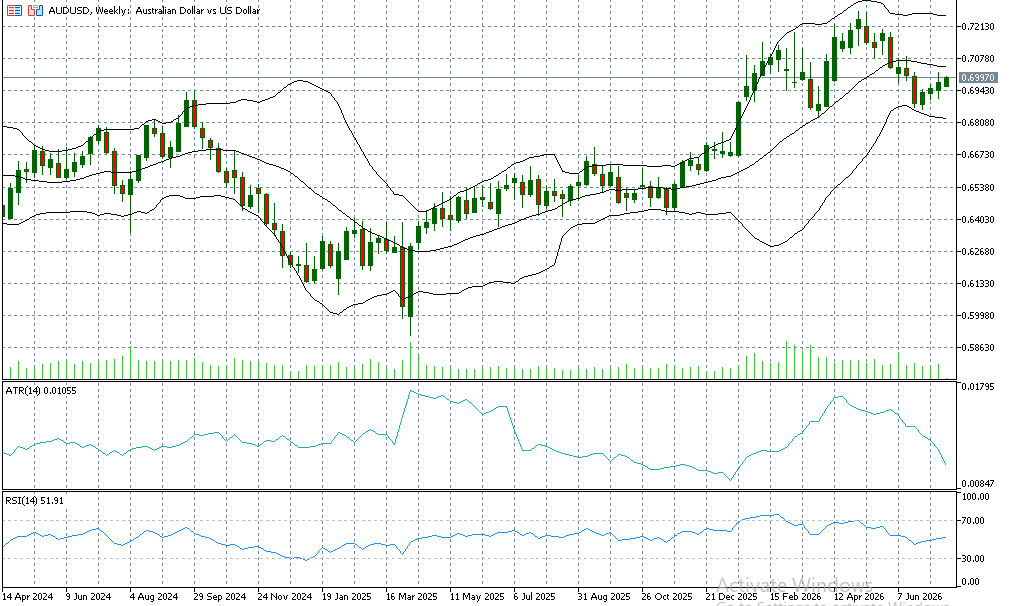
The Australian Dollar strengthened against the US Dollar during Monday’s European session, with the AUD/USD pair climbing above the key 0.7000 psychological level as broad-based weakness in the US Dollar encouraged buying interest. Although geopolitical tensions in the Middle East remain elevated, improving global risk sentiment provided support for risk-sensitive currencies, allowing the Australian Dollar to outperform during the session. Investor confidence improved modestly as European equity markets traded higher, reducing demand for traditional safe-haven assets such as the US Dollar. The softer Greenback enabled the AUD/USD pair to recover from an early bearish opening and extend gains despite ongoing geopolitical uncertainty.
Nevertheless, upside momentum for the Australian Dollar remained measured as tensions between the United States and Iran continued to intensify. The United States carried out another round of military strikes targeting Iranian positions, while Iran responded with ballistic missile and drone attacks against US-aligned assets in the region. The continued exchange of military action has increased concerns that the conflict could broaden further, keeping investors cautious toward higher-risk assets. US President Donald Trump reiterated that the United States would continue taking necessary measures to safeguard regional security and commercial shipping routes, while emphasizing that Washington remains prepared to respond to any further escalation. Meanwhile, diplomatic efforts remain ongoing as regional leaders continue discussions aimed at reducing tensions. Another key factor supporting the US Dollar is the continued closure and security concerns surrounding the Strait of Hormuz, a vital shipping route through which nearly one-fifth of global oil supplies pass. Higher crude oil prices resulting from supply concerns have renewed inflationary pressures globally, reinforcing expectations that the Federal Reserve may maintain a restrictive monetary policy for longer.
Federal Reserve officials have continued to emphasize that monetary policy decisions will remain data dependent, noting that inflation must continue moving sustainably toward the central bank’s target before any significant policy easing can be considered. The prospect of higher US interest rates and elevated Treasury yields continues to provide underlying support for the US Dollar, limiting the extent of its recent weakness. Despite these headwinds, the Australian Dollar continues to receive support from domestic fundamentals. The Reserve Bank of Australia has maintained a relatively hawkish policy stance, with policymakers indicating that inflation remains above target and that further policy adjustments will depend on incoming economic data. Expectations that Australian interest rates could remain elevated have improved the currency’s relative attractiveness.
Additional support for the Australian Dollar has come from resilient economic conditions in China, Australia’s largest trading partner. Recent Chinese economic indicators have pointed to steady domestic demand and improving business activity, helping support Australia’s export outlook and strengthening sentiment toward the commodity-linked currency. Looking ahead, market participants will continue monitoring developments in the Middle East, Federal Reserve commentary, US Treasury yields, and upcoming economic data from both the United States and Australia. While improving global risk sentiment has provided short-term support for the Australian Dollar, persistent geopolitical uncertainty and expectations of higher US interest rates are likely to keep the AUD/USD pair sensitive to changes in market sentiment over the near term.