

HG MARKETS:
Gold climbed to a three-week high on Wednesday as the U.S. dollar weakened following President Donald Trump’s announcement of a two-week ceasefire with Iran, halting planned attacks on the country’s civilian infrastructure.
Spot gold jumped 2.7%, hitting $4,832.51 per ounce, its highest since March 19.U.S. gold futures also climbed 2.7%, reaching $4,885.40 per ounce. The gains reflect increased safe-haven demand amid easing geopolitical tensions. Investors responded positively to news of the temporary U.S.–Iran ceasefire. Bullion prices are now at their strongest level in three weeks.
Other precious metals saw significant gains as well. Silver jumped 6% to $77.38 per ounce, and platinum climbed 4.2% to $2,044.60 per ounce.
Trump confirmed in a social media post that military action against Iran would be suspended for two weeks, noting that the U.S. had already achieved its key military objectives. The announcement came shortly before an 8:00 p.m. ET ( 5: 00 a.m PKT) deadline that investors had been closely monitoring for potential escalation.
Earlier, Trump had warned that “a whole civilization will die tonight” if Iran failed to comply. The ceasefire, brokered by Pakistan after urgent diplomatic efforts, is contingent on Iran ensuring the safe reopening of the Strait of Hormuz, a vital route for about 20% of global oil shipments.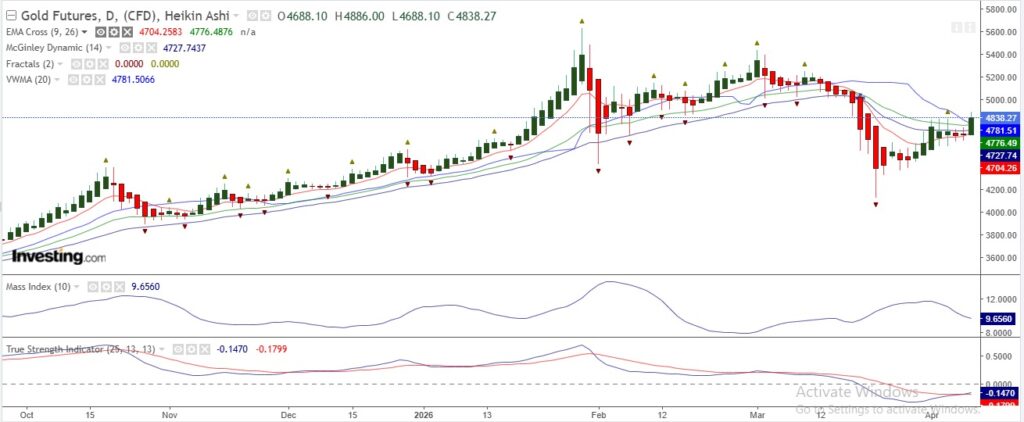
Iran expressed conditional willingness to de-escalate, stating that safe passage through the Strait would be allowed during the ceasefire if hostilities ceased and vessels coordinated with Iranian authorities. Trump also pledged U.S. assistance to reduce the shipping backlog in the Strait.
Financial markets reacted swiftly, with gold gaining as the U.S. Dollar Index fell nearly 1%, making bullion more attractive for international investors. Spot gold and futures surged, reflecting strong safe-haven demand amid easing geopolitical tensions.
Gold rose as the U.S. Dollar weakened, boosting its appeal for global investors. The safe-haven metal gained momentum ahead of the U.S. March consumer price index (CPI) report, which could affect inflation expectations and Federal Reserve policy.