

The US dollar remained close to a 19-month high on Friday and was heading towards its strongest weekly performance in two months, supported by rising expectations of a larger Federal Reserve interest-rate hike. Higher US Treasury yields strengthened the greenback against major currencies, while the Japanese yen weakened towards the key 160-per-dollar level, increasing concerns about possible government intervention.
US Treasury yields climbed as President Donald Trump’s remarks that “Washington no longer needed an agreement with Iran” heightened concerns over Middle Eastern energy supplies. The resulting uncertainty supported oil prices and increased inflation expectations, adding to pressure from recent US economic data indicating that inflation remains persistent. These developments have strengthened expectations that the Federal Reserve could consider a more aggressive monetary tightening approach next month.
The US two-year Treasury yield increased by 34 basis points over the previous two trading sessions, marking its sharpest two-day advance in approximately three and a half years, and reached 4.8602%. Meanwhile, the euro edged up 0.1% to $1.1059 but remained close to its weakest level since April 2025. The single currency was heading towards a 0.7% weekly decline, its largest weekly loss since late September.
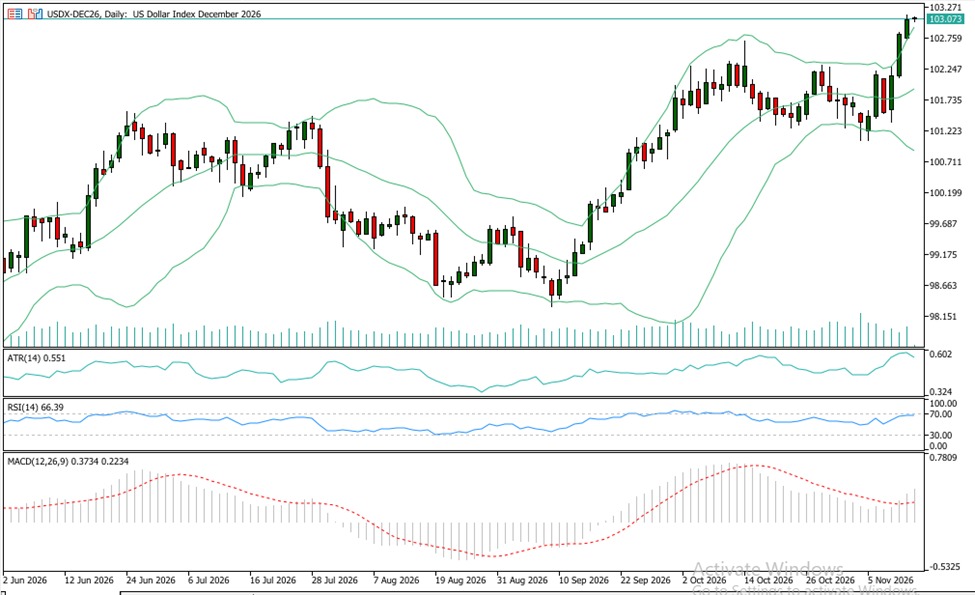
The US Dollar Index (DXY) stood at 103.18, holding near its highest level since April 2025. It was on track for a weekly gain of around 0.9%, marking its strongest performance since September. The dollar remained supported by strong market demand and expectations of tighter monetary policy.
However, a deeper sell-off in global equity markets, particularly technology stocks facing funding and regulatory concerns, could eventually weigh on the greenback. Rising market uncertainty may affect investor sentiment and increase volatility across currency markets.
Meanwhile, the Japanese yen remained under pressure, trading around 159.89 per dollar after briefly touching the 160 level earlier in the week. The currency was heading towards a 0.9% weekly decline, its weakest performance since September. Japan’s Finance Minister Satsuki Katayama warned that authorities would respond appropriately to excessive currency volatility, renewing concerns about possible intervention to support the yen.
The widening interest-rate gap between the United States and Japan has remained a major factor behind the yen’s weakness. Hawkish Federal Reserve expectations have strengthened the dollar’s yield advantage, outweighing support from expectations of further Bank of Japan monetary policy normalization. Japan previously spent 15.4 trillion yen, equivalent to approximately $96.47 billion, to support its currency after it weakened to a four-decade low of 163.99 per dollar in late July.