

Crude oil benchmarks remained largely range-bound during Wednesday’s trading session as market participants weighed the possibility of renewed U.S.–Iran diplomatic talks against the ongoing physical supply squeeze caused by the closure of the Strait of Hormuz. By early morning trading, Brent crude futures rose 43 cents (0.5%) to $95.22 a barrel, recovering slightly from a 4.6% plunge in the prior session. Simultaneously, U.S. West Texas Intermediate (WTI) crude futures edged down 17 cents (0.2%) to $91.11, following a sharp 7.9% drop on Tuesday. Looking toward the end of the second quarter, analysts project a divergent path based on geopolitical outcomes. In a bullish scenario where the blockade persists and waivers remain expired, Brent is forecasted to test the $105.00–$110.00 range, while WTI crude futures could see a corresponding climb toward $98.00–$102.00. Conversely, a successful diplomatic de-escalation could see prices retreat toward the $82.00–$85.00 support level as the “war premium” evaporates.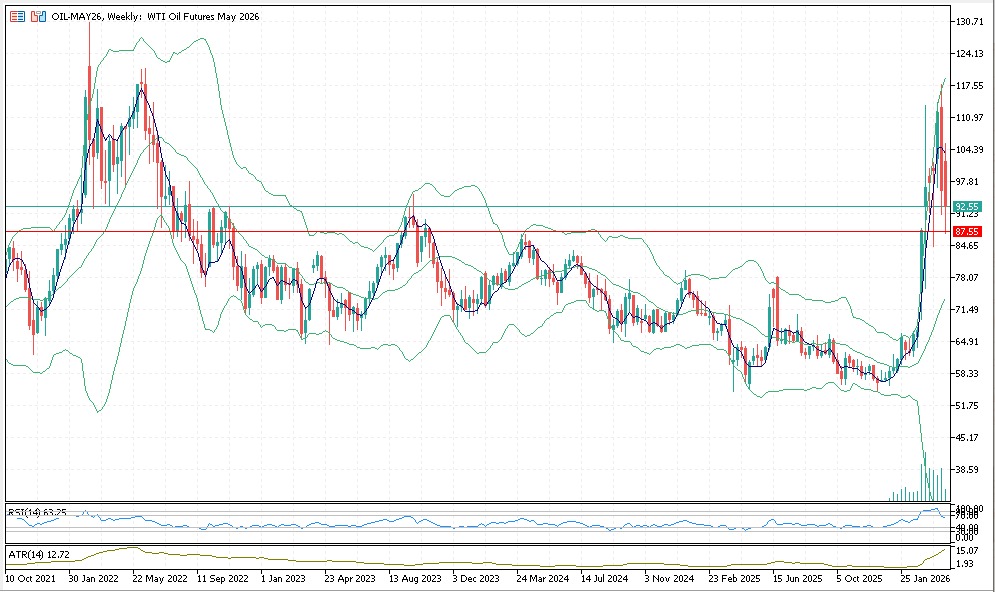
The conflict has effectively paralyzed the Strait of Hormuz, the world’s most critical maritime chokepoint for crude and refined products. Despite a nominal two-week ceasefire, daily traffic remains a mere fraction of the pre-war average of 130 crossings. While President Donald Trump signaled that negotiations with Tehran could resume this week, the tactical reality on the water remains restrictive. The U.S. military confirmed on Wednesday that a naval blockade has successfully halted maritime trade in and out of Iranian ports. The physical shortage of Middle Eastern grades has forced global refiners into a bidding war for alternative supply. This market tightness was highlighted on Tuesday when a cargo of WTI Midland for delivery to Rotterdam traded at a record premium of $22.80 a barrel over European benchmarks. As markets await official U.S. inventory data from the Energy Information Administration (EIA), the industry remains focused on the April 21 ceasefire deadline. Any failure to extend the halt in hostilities could see Brent re-test the $120 threshold seen earlier this March, potentially dragging WTI crude futures back into triple-digit territory.
The volatility inherent in current energy markets underscores the fragile balance between diplomatic optimism and physical scarcity. Ultimately, the trajectory of both Brent and WTI crude futures hinges on whether the April 21 deadline or the anticipated talks over the next two days yield a lasting resolution. For stakeholders, maintaining agility is paramount as the market prepares for either a sharp correction toward support levels or a rapid ascent back toward historic highs.