
The US Dollar Index (DXY), which gauges the dollar’s strength against six major currencies, remains in positive territory, although it has pared some of its earlier gains and is currently, trading around 99.00 on Monday.
The greenback gained support amid heightened demand for safe-haven assets following the breakdown of US–Iran peace negotiations. Vice President JD Vance confirmed that the talks in Islamabad concluded without reaching an agreement after nearly 21 hours of discussions.
US President Donald Trump announced plans to initiate a blockade on all ships entering or leaving the Strait of Hormuz, intensifying tensions in the region. Meanwhile, US Central Command (CENTCOM) verified that operational efforts targeting maritime traffic to and from Iranian ports had commenced at 10 AM ET = 7:00 PM (PKT) Monday.
The dollar’s strengthening was further supported by recent US inflation data. The March Consumer Price Index (CPI) figures reinforced the Federal Reserve’s stance on maintaining higher interest rates for an extended period. The US Bureau of Labor Statistics reported that annual CPI rose to 3.3% in March from 2.4% in February, aligning with market expectations.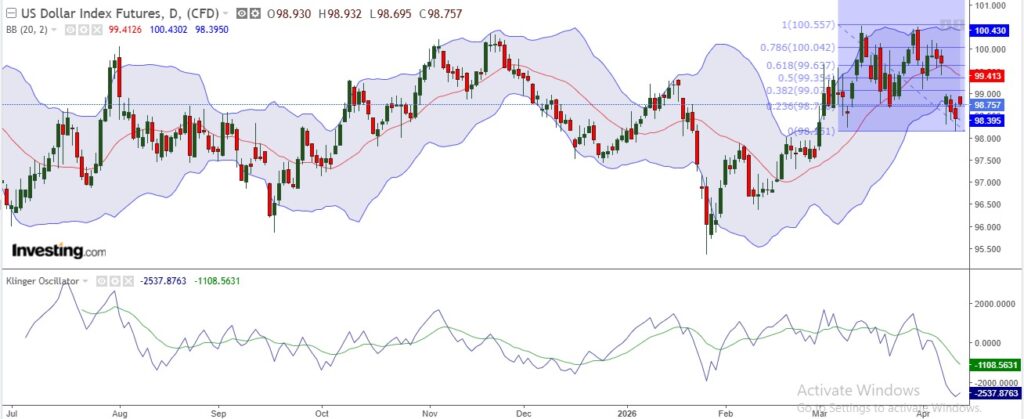
On a monthly basis, the CPI increased by 0.9%, up from 0.3% in the previous month. Additionally, core CPI, which excludes volatile food and energy prices, grew by 0.2% month-over-month and 2.6% year-over-year, indicating persistent inflationary pressures.
San Francisco Fed President Mary Daly commented to Reuters that if inflation remains elevated, the Federal Reserve is likely to hold interest rates steady until price stability is achieved. She also noted that a rate cut could be possible if the Iran conflict eases swiftly and oil prices decline accordingly.
Currently, the US Dollar Index hovers around the 99.00 level after trimming some of its recent gains, reflecting cautious market sentiment amid ongoing geopolitical tensions and inflation concerns.
Overall, the dollar’s recent performance highlights its sensitivity to geopolitical developments and economic data, with safe-haven demand and inflation dynamics playing crucial roles in shaping its trajectory.