

The US Dollar (USD) has recovered a portion of its earlier losses against the Japanese Yen (JPY) as the market transitions into the European trading session this Monday. At the time of writing, the pair is hovering near the 156.80 mark. This recovery follows a volatile Asian session where the pair plummeted approximately 150 pips in minutes, bottoming out at a session low of 155.70.
While the Japanese Ministry of Finance (MOF) has maintained its traditional silence regarding market operations, the “flash crash” characteristics of the decline notably the lack of an immediate fundamental catalyst and the synchronized appreciation of the Yen across all major crosses strongly suggest a fresh round of official intervention. This follows a Reuters report indicating that the Bank of Japan (BoJ) likely deployed roughly 5.48 trillion Yen ($35 billion) last week to defend the currency. Finance Minister Satsuki Katayama recently reinforced this aggressive stance, warning speculators of “decisive action” after the pair breached the 160.00 threshold, a level now widely viewed as the MOF’s “line in the sand.”
Global market sentiment remains cautiously optimistic, though heavily influenced by developments in the Middle East. Investor focus is squarely on the Strait of Hormuz following President Trump’s pledge to lead a maritime effort to free stranded commercial vessels. While the details of “Project Freedom” remain sparse, the geopolitical risk premium persists as Iranian authorities maintain that the waterway remains closed, potentially offsetting any downward pressure on oil prices.
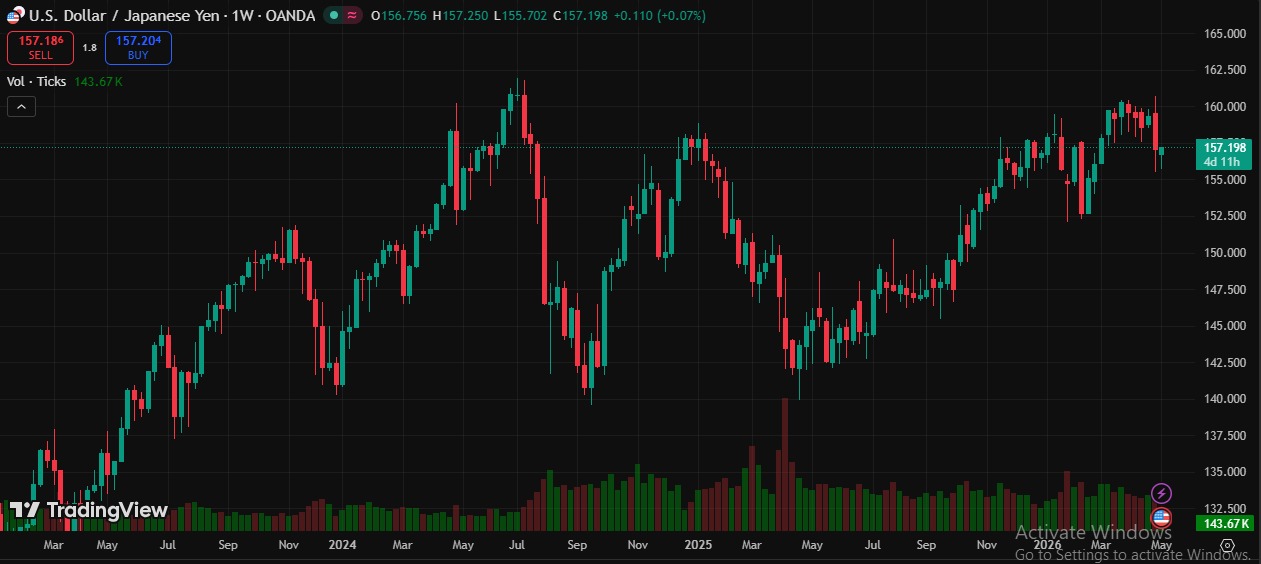
As Japan observes the Golden Week holidays, domestic economic data remains scarce, shifting the analytical focus toward the United States. Today’s Factory Orders will set the stage for a critical week of data, including the ISM Services PMI and a comprehensive suite of labor market updates, culminating in Friday’s Nonfarm Payrolls (NFP) report. These figures, coupled with scheduled remarks from various Federal Reserve officials, will be instrumental in determining whether the interest rate differential between the U.S. and Japan will continue to exert upward pressure on the pair, potentially necessitating further intervention by Tokyo.
For market participants, the efficacy of these interventions remains a subject of intense debate. While the MOF’s “shock and awe” tactics successfully cleared out over-leveraged short positions at the 160.00 handle, the fundamental divergence in monetary policy remains the primary headwind for the Yen. Unless U..S. economic data begins to show a meaningful cooling thereby allowing the Fed to signal a dovish pivot temporary liquidity injections by the BoJ may only serve to provide attractive “buy-the-dip” opportunities for long-term dollar bulls. Consequently, traders are bracing for a high-volatility environment where technical resistance levels are increasingly defended by political mandate rather than market consensus alone.