

USD/JPY remained firmly bid above the 161.00 level on Friday after a fresh wave of buying pushed the pair to 161.80 on Thursday, just shy of the four-decade high of 161.95 recorded in June 2024. The pair has maintained a strong upward trajectory since breaking through the psychologically important 160.00 barrier, supported by renewed demand for the US dollar. Market sentiment was boosted by the Federal Reserve’s hawkish tone, with policymakers signaling the possibility of another interest-rate increase later in the year, reinforcing the dollar’s yield advantage.
Despite the broader bullish trend, Friday’s price action was relatively subdued, forming a narrow Doji candlestick pattern. This reflected a temporary pause in momentum rather than a reversal, as the overall market structure remained constructive for further gains. However, technical indicators continued to point toward overbought conditions, suggesting that traders may become increasingly cautious at elevated levels. Concerns about potential intervention from Japanese authorities also contributed to the restrained trading activity.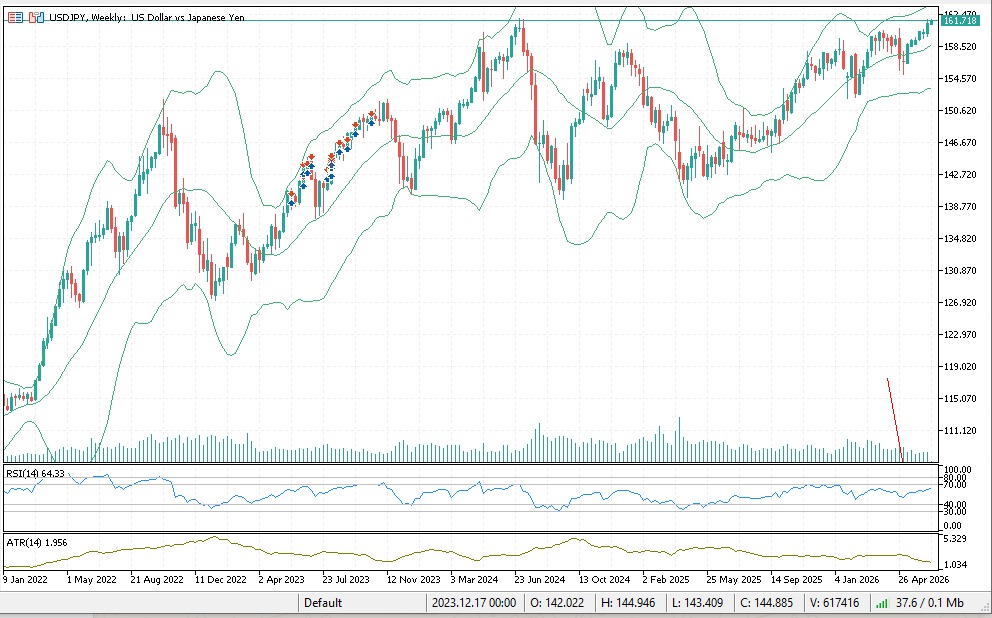
Japanese officials have repeatedly expressed concern over the yen’s rapid depreciation. The country’s Finance Minister reiterated that authorities are prepared to take decisive measures if currency movements become excessive or disorderly. These warnings have kept intervention risks firmly on traders’ radar, especially as the exchange rate approaches levels that previously prompted government action. Market participants remain alert for any signs of direct intervention aimed at stabilizing the currency.
At the same time, some investors believe Japanese authorities may continue relying on verbal warnings rather than immediate market action. Under this scenario, the yen could weaken further, potentially allowing USD/JPY to break decisively above the 162.00 threshold. Such an outcome would likely attract additional momentum-driven buying, particularly if US economic data and Federal Reserve policy expectations continue to favor the dollar.
On Monday, the Japanese yen traded around 161.5 per dollar, hovering near its weakest level since 1986. The currency has now erased all the gains achieved after the record-sized intervention conducted on April 30. Although the Bank of Japan has continued its policy normalization efforts, including a recent 25-basis-point rate increase that lifted interest rates to 1%, the yen remains under pressure. Persistent carry-trade demand and the substantial interest-rate differential between Japan and the United States continue to encourage investors to maintain short yen positions, limiting the impact of both policy tightening and official warnings.